
Micron DRAM selection begins with the processor memory controller, not with a familiar density or speed label. As retrieved on 10 August 2026, Micron’s Memory portfolio separates DRAM components, DRAM modules, LPDDR components, LPDDR modules, high-bandwidth memory and graphics memory. Each branch has different electrical, mechanical and qualification assumptions. This guide turns those branches into a release process for engineers and sourcing teams.
The goal is an exact manufacturer part number that the controller supports, the PCB can route, the power tree can supply and the product lifecycle can sustain. A catalog row can support that decision, but it cannot prove system compatibility by itself. Current controller documentation, the exact Micron data sheet, package drawings, lifecycle evidence and board-level qualification must agree before release.
Key takeaways
- Choose DDR, LPDDR or a module from controller support and system architecture first.
- Micron lists DDR5 at 4800 to 8800 MT/s and DDR4 at 600 to 3200 MT/s on its current DDR5 page.
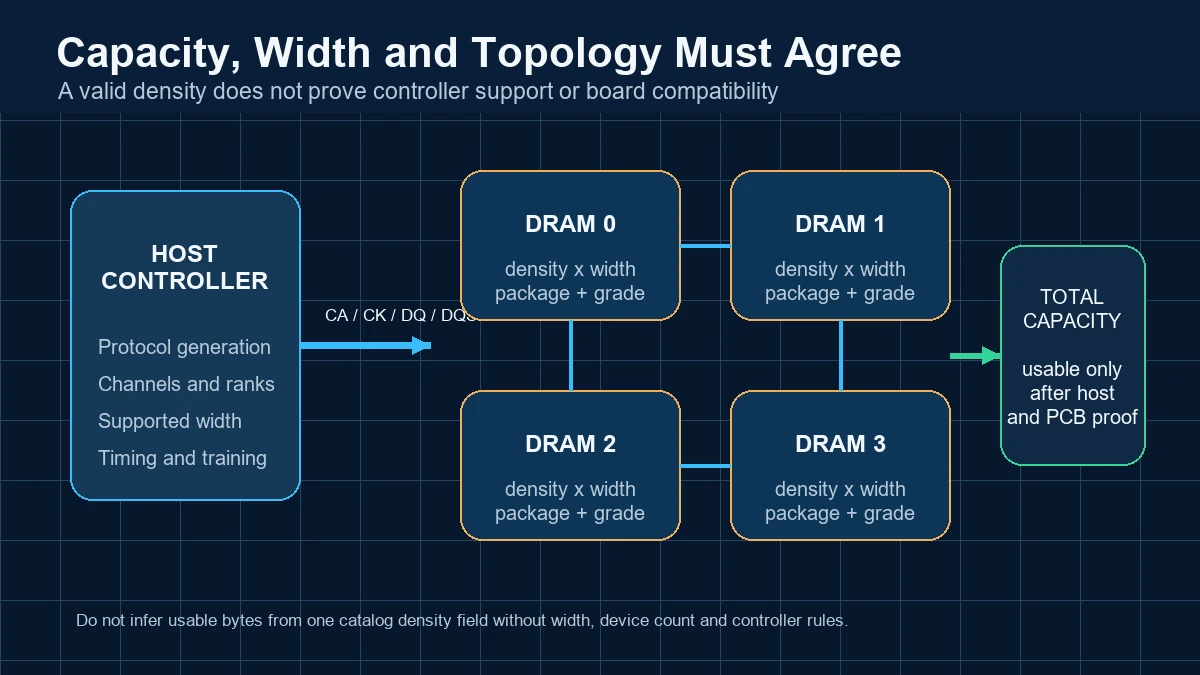
- Density, device width and device count must be translated into usable capacity and routing topology.
- Package, temperature grade, speed grade, revision and lifecycle suffixes are release-critical.
- Do not publish a product backlink until the exact target page passes live product QA.
What is the Micron DRAM and mobile memory portfolio?
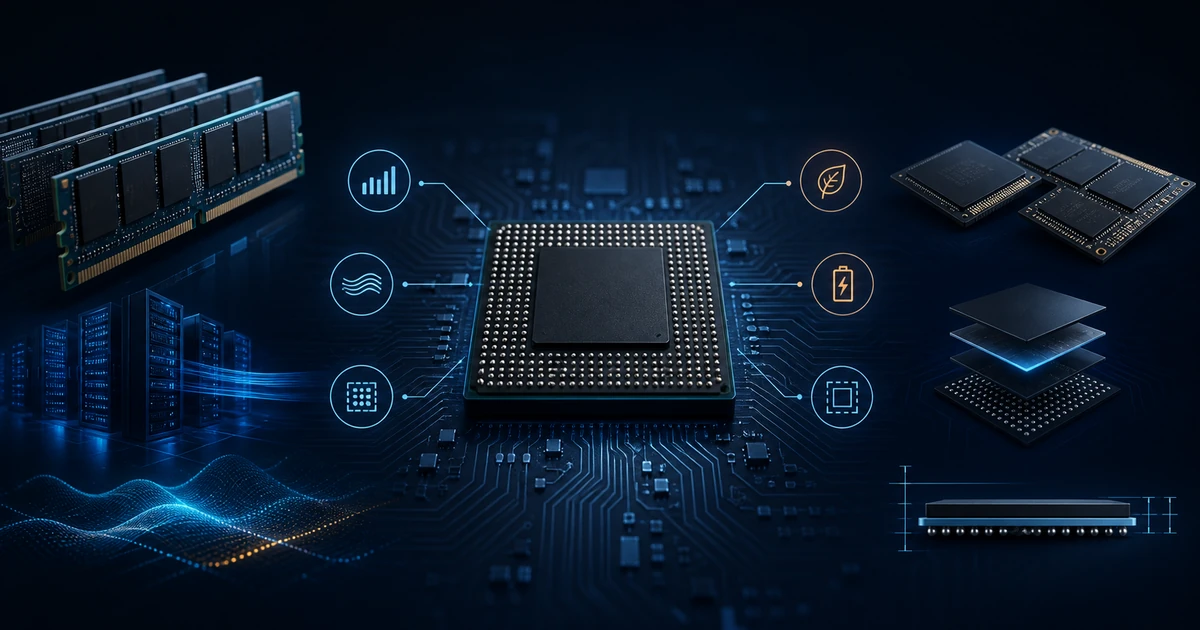
Micron presents six major memory branches on its current portfolio page: DRAM components, DRAM modules, LPDDR components, LPDDR modules, high-bandwidth memory and graphics memory. That count matters because “DRAM” is a storage-cell technology, not one interchangeable interface. DDR5, DDR4 and LPDDR devices need different controllers, power rails, packages, training flows and board rules.
For embedded and industrial selection, the first practical split is component versus module. A component is normally soldered directly to the PCB and exposes the memory interface at package balls. A module combines multiple devices, routing and identification data on a standardized form factor. The module can reduce assembly complexity, but it adds connector, height, airflow and platform constraints.
LPDDR is another architectural branch, not merely lower-voltage DDR. Micron’s LPDDR components overview lists LPDDR5X, LPDDR5, LPDDR4/4X and legacy LPDDR lines. The processor must explicitly support the chosen protocol, width, training and package arrangement. A pin-compatible assumption based on density or marketing generation is unsafe.
Engineering interpretation: Treat the portfolio page as a map, the product catalog as a filter and the exact data sheet as the controlling specification. This three-level evidence model prevents a broad family statement from being copied into an exact order-code release.
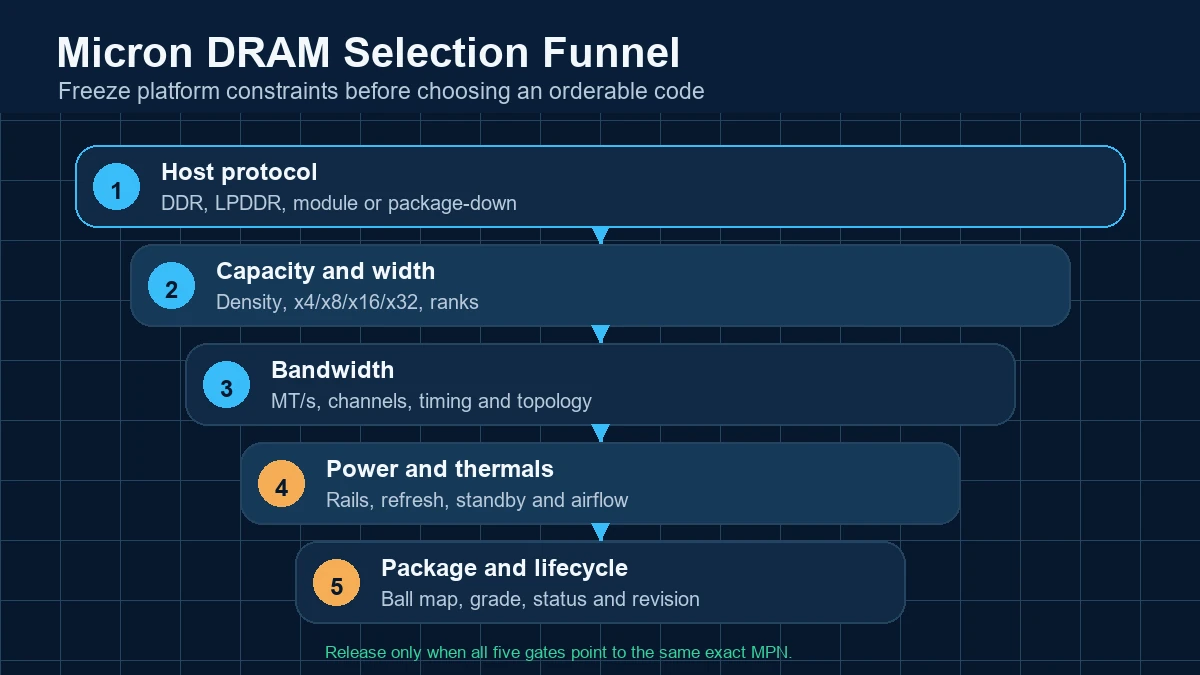
Should you choose DDR, LPDDR, a module or package-down memory?
Micron’s memory portfolio exposes four relevant implementation paths before specialized HBM or graphics memory is considered: DRAM components, DRAM modules, LPDDR components and LPDDR modules. Choose among them by host support, replaceability, power budget and mechanical design. Do not start with a target gigabyte number and work backward from distributor listings.
| Architecture | Best starting condition | Release-critical checks | Main selection risk |
|---|---|---|---|
| DDR component | Controller supports the exact DDR generation and board-level implementation | Width, ranks, topology, timing, rails, package and training | A valid density is mistaken for controller compatibility |
| DDR module | Platform supports the module type and connector | UDIMM, SODIMM, RDIMM or other form factor, capacity, rank, ECC and SPD support | Module type is incompatible with the processor or motherboard |
| LPDDR component | Power-sensitive, package-down design with explicit LPDDR controller support | Protocol, package, ball map, channels, power states, temperature and solder process | DDR and LPDDR are treated as interchangeable |
| LPDDR module | Platform supports the newer low-power modular form factor | Connector, BIOS support, capacity, speed and platform qualification | A component catalog is used to justify a module decision |
Micron’s current DRAM modules page includes module families for server, workstation and client use. Its module reference guide lists data rates and form factors separately. That separation is useful: a data rate does not establish that a CPU accepts the module’s buffering, ECC organization, rank structure or SPD profile.
How do DDR4 and DDR5 change the board decision?
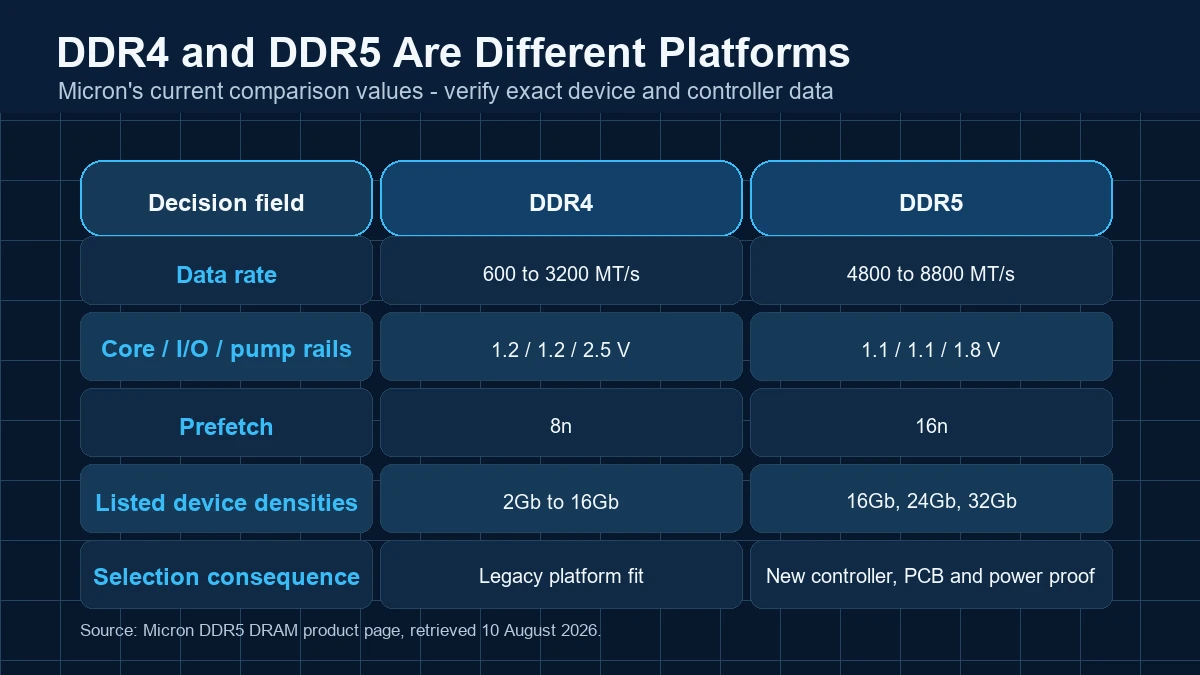
Micron’s current DDR5 DRAM page compares DDR4 at 600 to 3200 MT/s with DDR5 at 4800 to 8800 MT/s. It also lists DDR4 rails of 1.2, 1.2 and 2.5 V against DDR5 rails of 1.1, 1.1 and 1.8 V. These are platform-level differences, not speed-bin substitutions.
The same comparison lists 8n prefetch for DDR4 and 16n for DDR5. Listed device densities move from 2Gb to 16Gb for DDR4 to 16Gb, 24Gb and 32Gb for DDR5. DDR5 also changes bank organization and adds features such as on-die ECC. On-die ECC improves internal array reliability, but it does not replace the system-level protection provided by an ECC-capable controller and data path.
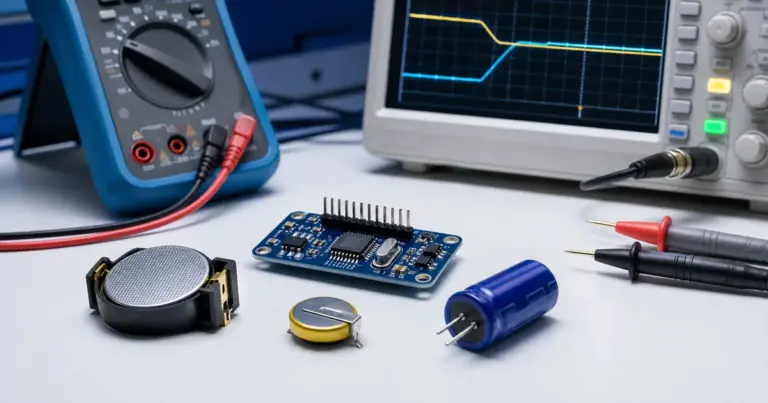
Electrical qualification must therefore cover more than nominal voltage. Verify the controller’s supported data rates, topology and training behavior. Build the power budget from the exact device and workload. Simulate or measure signal integrity with the real stack-up, termination and package models. Validate startup, reset, refresh, temperature corners and sustained traffic on the assembled design.
When does LPDDR make sense for mobile and embedded systems?
Micron’s LPDDR overview currently divides low-power memory into four generations: LPDDR5X, LPDDR5, LPDDR4/4X and legacy LPDDR. LPDDR is appropriate when the processor supports it and energy, standby behavior or compact package-down integration matters more than socketed replaceability. It is used beyond phones, including automotive, networking and thin client systems.
Micron’s LPDDR5 product page lists a maximum of 6400 Mb/s and describes a 20% power-efficiency improvement over LPDDR4X. The broader LPDDR page also describes LPDDR5X options up to 10.7 Gb/s with more than 15% power saving over the prior generation. These family claims help frame architecture, but they do not set the performance of every orderable device.
Package-down integration moves risk into the PCB and production process. Verify the processor’s channel mapping, supported densities, package ball map, escape routing, impedance, training sequence and firmware settings. Confirm reflow profile, warpage limits, underfill policy if applicable and inspection method. A later substitution may require a board spin even when capacity and protocol appear unchanged.
Selection rule: Low power is a system result. Compare active bandwidth efficiency, idle states, refresh behavior, rail conversion losses and thermal conditions. A lower nominal I/O voltage alone does not prove lower energy for the real workload.
How do density, bus width and device count become usable capacity?
Micron’s DDR4 catalog exposes bus widths such as x4, x8 and x16, while its LPDDR5 catalog includes x32 configurations. These values describe the data width of a device, not the total width or capacity of the finished system. Capacity must be calculated with device density, device count, channel organization, ranks and any reserved regions.
Start with the controller’s supported configurations. A host may support only specific densities, widths or rank counts at a given speed. Then map each DQ, DQS, command/address and clock group to the exact package. Confirm whether multiple devices share command/address signals and how the topology affects loading. The same total capacity can require different routing when built from x8 versus x16 devices.
Do not confuse bits with bytes. A 16Gb device contains 2GB of raw bit capacity before system-level reservations, because eight bits form one byte. Four such devices provide 8GB of raw capacity if the controller supports the organization. That arithmetic is necessary, but it still does not prove boot, training, refresh or timing compatibility.
Which speed values can be compared without creating false equivalence?
Micron’s DDR5 FAQ distinguishes clock frequency in MHz from transfer rate in MT/s: double-data-rate memory transfers on both clock edges. A 3200 MT/s label is therefore not a 3200 MHz command clock. Compare like units, then check the exact data sheet’s supported timing set and the controller’s maximum validated rate.
Catalog fields may expose speed, MT/s and CAS latency together, but these values describe different parts of performance. The application sees bandwidth and latency through controller scheduling, channel count, ranks, access pattern and refresh interference. A higher peak transfer rate can still underperform if the controller down-bins the device or if the board cannot meet signal margin.
Record the source and retrieval date for every numeric field used in a shortlist. If a catalog, family page and data sheet disagree, stop. Resolve the conflict through the current exact-device document or manufacturer support. Never average values or silently select the number that best fits the intended design.
What must be verified in the exact Micron order code?
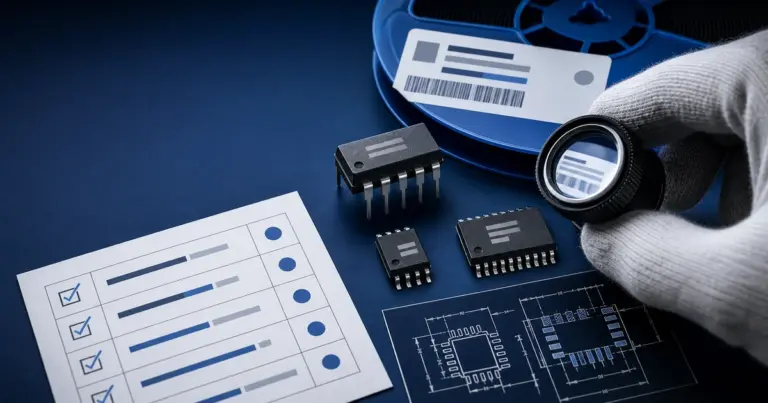
Micron publishes separate part-numbering material for current modules and legacy Elpida memory. Those guides show why an exact suffix matters: product family, organization, package, speed grade, temperature or special options can be encoded in different positions. Decode the complete orderable code with the guide that applies to that family and revision.
At minimum, verify the base technology, density, width, package drawing, ball count, package dimensions, speed grade, operating temperature and lifecycle status. Also check die or stack count where exposed, final packing options and any customer-specific suffix. For legacy parts, use the obsolete catalog and product-change records rather than assuming a current naming pattern applies.
Package identity deserves its own gate. Two BGA devices can share a ball count yet differ in body size, pitch, ball map, height or thermal behavior. Compare the dimensioned package drawing and pin assignment, not the package acronym alone. The Micron design tools page links the FBGA decoder, power calculators, simulation models, chipset guides and cross-reference resources used during this work.
How should lifecycle and legacy status affect a new selection?
Micron catalog rows use lifecycle labels such as Production, Contact Sales, End of Life and Obsolete. The DDR4 catalog currently contains examples of all four states. Treat the displayed status as dated evidence, not a permanent property. Capture it in the release record and recheck it before prototype purchase, qualification build and production commitment.
Micron’s DRAM for legacy designs page retains DDR3, DDR2, DDR, SDR SDRAM and RLDRAM paths. Extended legacy support is valuable, but it does not guarantee that any particular code is active, stocked or recommended for a new design. Exact lifecycle status, change notifications and available documentation still control.
For a redesign, separate functional equivalence from drop-in replacement. A newer memory may offer the required capacity, but a different protocol generation, rail set, package or initialization sequence can force controller, PCB and firmware changes. Create a difference table and qualification plan before calling an alternate suitable.
How should a Micron DRAM choice be qualified?
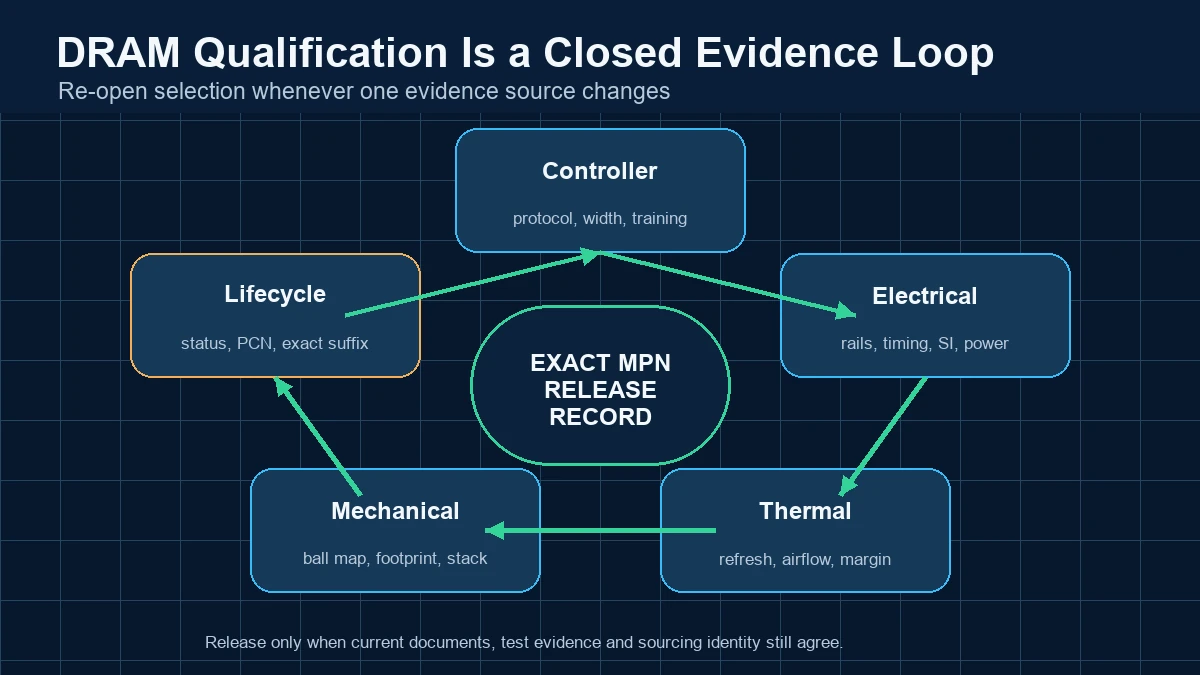
A useful DRAM qualification plan covers five evidence domains: controller, electrical, thermal, mechanical and lifecycle. Each domain can invalidate the same exact MPN. Closing four of five gates is not enough because the unresolved gate can cause a boot failure, data corruption, assembly defect or sourcing interruption.
| Gate | Evidence to retain | Minimum design checks |
|---|---|---|
| Controller | Processor data sheet, compatibility guide, firmware configuration | Protocol, density, width, ranks, data rate, training and reset |
| Electrical | Exact memory data sheet, IBIS or simulation model, power model | Rails, sequencing, timing, termination, SI, PI and margin |
| Thermal | Power estimate, board measurement and enclosure test | Refresh behavior, airflow, hot spots and temperature corners |
| Mechanical | Package drawing, land pattern and assembly record | Ball map, pitch, body size, height, reflow and inspection |
| Lifecycle | Catalog status, PCN or EOL notice, approved-source record | Exact suffix, revision, date, packing and replacement plan |
Test patterns should cover cold and warm boot, repeated reset, maximum sustained traffic, mixed reads and writes, temperature extremes, voltage margin and long idle intervals. Include error logging that separates controller training failure from application-level corruption. If ECC exists at one layer, document what it protects and what it does not.
Release discipline: Put the exact order code, document revisions, controller settings, PCB revision and test results in one qualification record. If any one of those fields changes, reopen the affected gates. This is faster than diagnosing a silent substitution after production has started.
What should engineering send to procurement?
A complete handoff contains at least one exact MPN, quantity, target build date, delivery region, acceptable date-code range and lifecycle constraints. Add package, temperature grade, speed grade, revision and qualification status. If alternates are allowed, state which differences require engineering approval and which fields are fixed.
Attach the controlling data sheet, package drawing, controller compatibility evidence and qualification summary. Procurement should not be asked to infer a suffix or substitute a nearby catalog row. If the exact code is unavailable, route the response back through engineering with documented differences rather than changing the BOM silently.
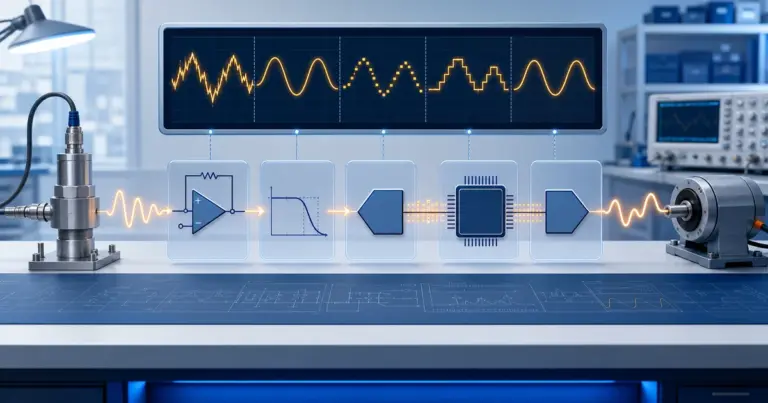
For adjacent mixed-signal work, the analog signal-chain selection guide uses the same evidence-first release method. To submit an exact memory requirement, use the component RFQ form with the controller, package and lifecycle constraints already collected.
Frequently asked questions
Can DDR4 memory be replaced by DDR5?
No. Micron’s current DDR5 comparison lists different data-rate ranges, rail voltages and prefetch lengths: DDR4 is shown at 600 to 3200 MT/s with 8n prefetch, while DDR5 is shown at 4800 to 8800 MT/s with 16n prefetch. The controller, PCB, power and firmware must support the chosen generation.
Is LPDDR always lower power than DDR?
LPDDR is designed for lower-power operation, but system energy still depends on workload, channels, refresh, standby states and voltage conversion. Micron describes LPDDR5 as up to 20% more power efficient than LPDDR4X. Use the exact device model and measured workload before converting that family claim into a product power budget.
What is the difference between MHz and MT/s for DRAM?
MHz describes clock frequency, while MT/s describes data transfers per second. Micron explains that double-data-rate memory transfers on both clock edges. A 3200 MT/s device is therefore not operating with a 3200 MHz base clock. Keep units explicit in BOMs, comparison tables and controller settings.
How do you calculate DRAM capacity from device density?
Divide the device density in gigabits by eight to obtain gigabytes per device, then multiply by the supported device count. For example, one 16Gb device contains 2GB of raw capacity. Controller width, ranks, channel rules and reserved regions still determine whether the full calculated capacity is usable.
Does on-die ECC make a DDR5 system fully ECC protected?
No. Micron’s DDR5 comparison lists on-die ECC as a DDR5 feature, but it protects internal array operations rather than the complete data path. End-to-end ECC requires support across the controller, memory organization and system design. Document each protection boundary instead of treating the three-letter label as universal coverage.
Verification record and review cadence
This guide was verified on 10 August 2026 against Micron primary sources. Numeric claims were retained only when the current manufacturer page exposed them clearly. Exact-device claims were not inferred from a family page. Product links remain subject to live HTTP, canonical, indexability, schema, sitemap and content QA before public insertion.
- Micron, Memory, retrieved 2026-08-10: https://www.micron.com/products/memory
- Micron, DRAM components, retrieved 2026-08-10: https://www.micron.com/products/memory/dram-components
- Micron, DDR5 DRAM, retrieved 2026-08-10: https://www.micron.com/products/memory/dram-components/ddr5-sdram
- Micron, DDR4 SDRAM, retrieved 2026-08-10: https://www.micron.com/products/memory/dram-components/ddr4-sdram
- Micron, LPDDR components, retrieved 2026-08-10: https://www.micron.com/products/memory/lpddr-components
- Micron, LPDDR5, retrieved 2026-08-10: https://www.micron.com/products/memory/dram-components/lpddr5
- Micron, DRAM modules, retrieved 2026-08-10: https://www.micron.com/products/memory/dram-modules
- Micron, DRAM for legacy designs, retrieved 2026-08-10: https://www.micron.com/products/memory/dram-components/dram-legacy
Recheck family values and catalog status before every major design review. Recheck the exact data sheet, package drawing and lifecycle evidence whenever the MPN, suffix, PCB, controller firmware or operating envelope changes. Public product backlinks should be re-audited after every related product-page update.
Conclusion
Choose Micron DRAM from the host outward. Freeze the protocol generation, supported density and width, topology, data rate, power states, package and operating envelope before decoding an exact order code. Then close controller, electrical, thermal, mechanical and lifecycle evidence against the same MPN.
The most expensive memory error is rarely a missing catalog filter. It is a hidden mismatch between two individually plausible facts. A disciplined release record makes those mismatches visible before the BOM reaches production. ICEARTH can review sourcing requirements once engineering has supplied the exact MPN and the constraints that must not change.
Continue the engineering review
From this guide to exact component data
Browse product recordsAll engineering guidesSourcing resources