
A TCXO RTC justifies its added component and power budget when a product must hold time across temperature without frequent synchronization. A conventional crystal RTC remains sensible when the system can tolerate minutes of annual drift, calibrate after assembly or regularly receive trusted time. The architecture, not the RTC label alone, determines the result.
Analog Devices gives a useful scale: a typical 32.768 kHz tuning-fork crystal at +25°C has about ±20 ppm accuracy, equal to 1.7 seconds per day or 10.34 minutes per year. Its DS3231S integrated RTC/TCXO/crystal specifies ±2 ppm from 0°C to +40°C (Analog Devices, Timekeeping Accuracy, Automatic and Affordable, 2005).
For the wider architecture context, start with the real-time clock IC selection guide. Then use the exact product data sheet for design release.
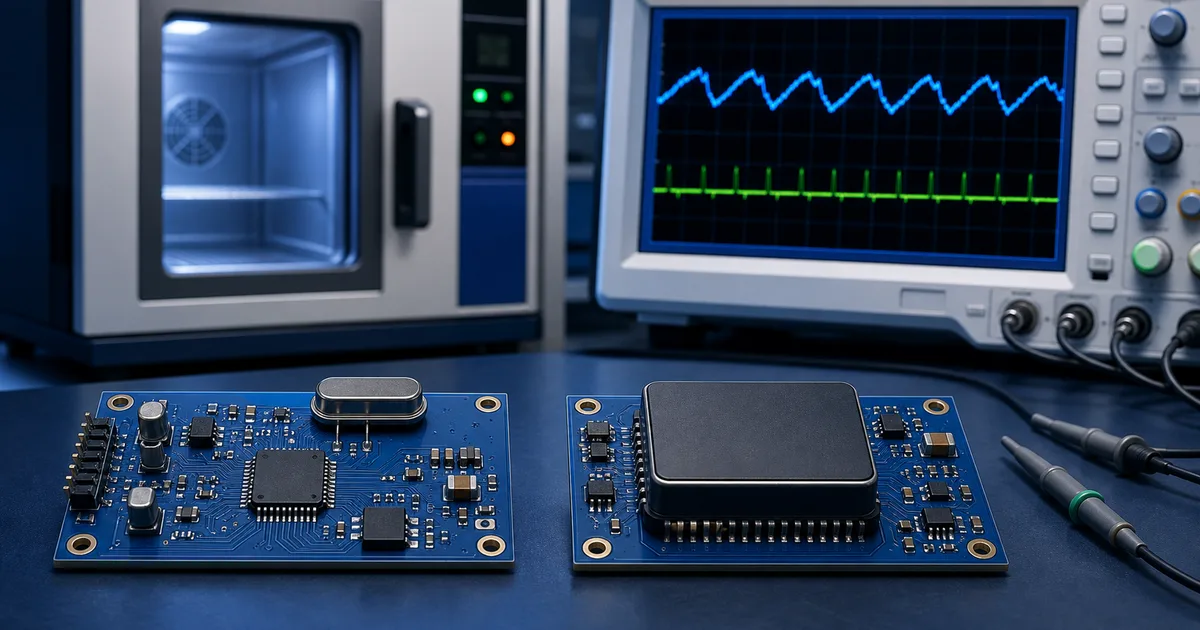
What do crystal RTC, integrated-crystal RTC and TCXO RTC mean?
Analog Devices specifies DS1337 for a 32.768 kHz, 6 pF crystal, while DS1337C places a compatible crystal inside a 16-pin package. Neither fact implies temperature compensation. DS3231S instead combines the RTC, crystal and TCXO, which actively corrects oscillator frequency as temperature changes (Analog Devices, DS1337/DS1337C Data Sheet, 2015).
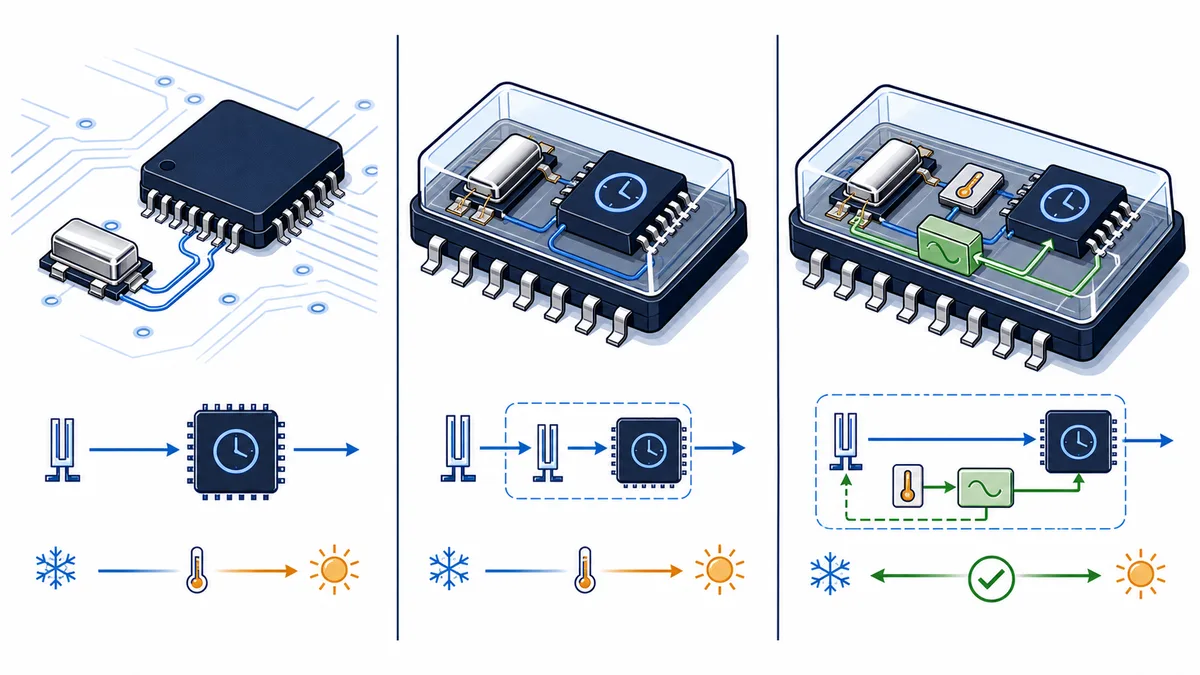
External crystal
The DS1337 product page represents an external-crystal RTC. The designer selects and places its 32.768 kHz, 6 pF quartz resonator, making crystal qualification, oscillator layout and assembly cleanliness system responsibilities.
Integrated crystal
An integrated-crystal RTC puts the die and compatible quartz in one package. Analog Devices says this removes separate crystal procurement and layout work. However, its technical article states that DS1337C-style integration alone does not improve accuracy. Packaging convenience and temperature compensation remain separate attributes.
TCXO
A TCXO adds temperature sensing and correction. DS3231S control logic reads an on-chip sensor, uses a lookup table and adjusts a capacitor array. Quartz remains the resonator; TCXO names the compensation system around it.
Selection insight: Ask where the crystal sits and whether its frequency is compensated. Those independent questions prevent an integrated, uncompensated crystal from being mistaken for a TCXO.
Citation capsule: Analog Devices identifies DS1337C as a 16-pin integrated-crystal RTC, but says this package does not inherently improve accuracy. DS3231S differs because it integrates an RTC, crystal and TCXO, with ±2 ppm specified from 0°C to +40°C.
How much accuracy does a TCXO RTC buy?
A typical tuning-fork crystal is about ±20 ppm at +25°C, equal to 1.7 seconds per day or 10.34 minutes yearly. Analog Devices says error can become much worse than 150 ppm at temperature extremes. DS3231S specifies ±2 ppm from 0°C to +40°C and ±3.5 ppm above +40°C to +70°C.
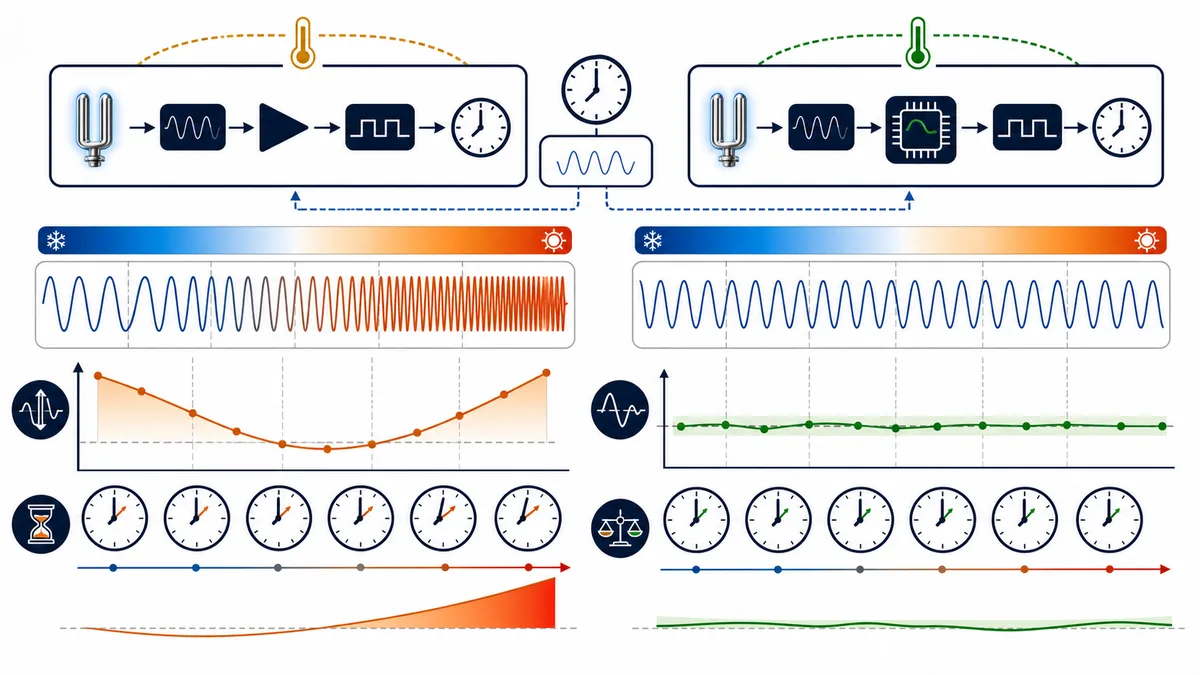
An uncompensated tuning-fork crystal follows a parabolic frequency curve across temperature. Screening can improve its room-temperature starting point, but it cannot flatten that curve. A TCXO changes crystal loading to counter the predictable deviation.
DS3231 accuracy still has boundaries. DS3231S operates from 0°C to +70°C, while DS3231SN covers -40°C to +85°C. The data sheet lists crystal aging after reflow at ±1 ppm in year one and ±5 ppm over 0 to 10 years (Analog Devices, DS3231 Data Sheet, Rev. 10, 2015).
Engineering insight: Convert ppm into allowed error over the unsynchronized interval. Daily-synchronized equipment may tolerate a basic crystal. A sealed meter holding time through a seasonal outage may not.
Citation capsule: Analog Devices equates a typical ±20 ppm tuning-fork crystal at +25°C with 10.34 minutes of annual drift. DS3231S specifies ±2 ppm from 0°C to +40°C and ±3.5 ppm above +40°C to +70°C, before aging and system errors.
When does the accuracy difference justify a TCXO?
DS3231 measures temperature every 64 seconds and adjusts crystal load capacitance, according to Analog Devices. That compensation is justified when temperature-driven holdover error matters more than added power and unit cost. If the product resynchronizes often, remains near room temperature or accepts manual correction, a basic crystal RTC may be enough (Analog Devices, Power Considerations for Accurate Real-Time Clocks, 2010).
TCXO usually wins in metering, event evidence, offline industrial controls and remote assets. A wrong timestamp can invalidate sequencing, billing or audit records. A crystal RTC usually wins in connected or user-set products that synchronize from GNSS, a network or a host.
Power can reverse the decision. DS1337 specifies 425 nA typical and 600 nA maximum timekeeping current under stated low-voltage conditions. DS3231 specifies 0.84 µA typical and 3.0 µA maximum battery timekeeping current at 3.63 V. Because test conditions differ, use these values as architecture signals, not drop-in comparisons.
Need a concrete part-level comparison? See DS1337+ vs DS3231S# for interface, oscillator, package and operating differences.
Citation capsule: Analog Devices specifies DS1337 timekeeping current at 425 nA typical and 600 nA maximum, while DS3231 battery timekeeping current is 0.84 µA typical and 3.0 µA maximum at 3.63 V under stated conditions. TCXO accuracy therefore carries a measurable holdover-power trade-off.
How should a crystal RTC and TCXO RTC be compared?
Analog Devices states that 23 ppm is approximately one minute per month, a practical threshold for early screening. Choose the architecture that meets the complete error and power budgets, not the smallest headline ppm. This table separates external crystal, integrated uncompensated crystal and integrated TCXO approaches (Analog Devices, Design Considerations for Analog Devices Real-Time Clocks, 2002).
| Decision factor | External-crystal RTC | Integrated-crystal RTC | Integrated TCXO RTC |
|---|---|---|---|
| Example | DS1337 | DS1337C | DS3231S or DS3231SN |
| Timebase | Designer-selected crystal | Crystal inside package | Integrated crystal with temperature compensation |
| Accuracy basis | Crystal, load, layout, temperature and aging | Same uncompensated behavior, with fewer layout variables | Specified compensated ppm band |
| Sourcing work | Highest | Lower | Lower |
| Calibration | May need screening or correction | May still need correction | Factory compensated, aging trim available |
| Holdover power | Potentially lowest | Architecture dependent | Temperature correction adds current |
| Best fit | Synchronized, moderate-accuracy systems | Simpler assembly without TCXO need | Long holdover across temperature |
| Main risk | Wrong load, ESR or layout | Assuming integration means TCXO | Wrong S versus SN grade |
The table filters architectures; it does not approve substitutions. Use the DS3231S product page and current manufacturer documentation for the commercial-grade selection.
What should engineers and buyers verify before release?
DS1337 requires a 6 pF crystal and supports a 400 kHz I²C interface, while DS3231S operates from 0°C to +70°C and DS3231SN extends from -40°C to +85°C. Those three specifications show why design and procurement must preserve oscillator, interface and temperature-grade details through the BOM process.
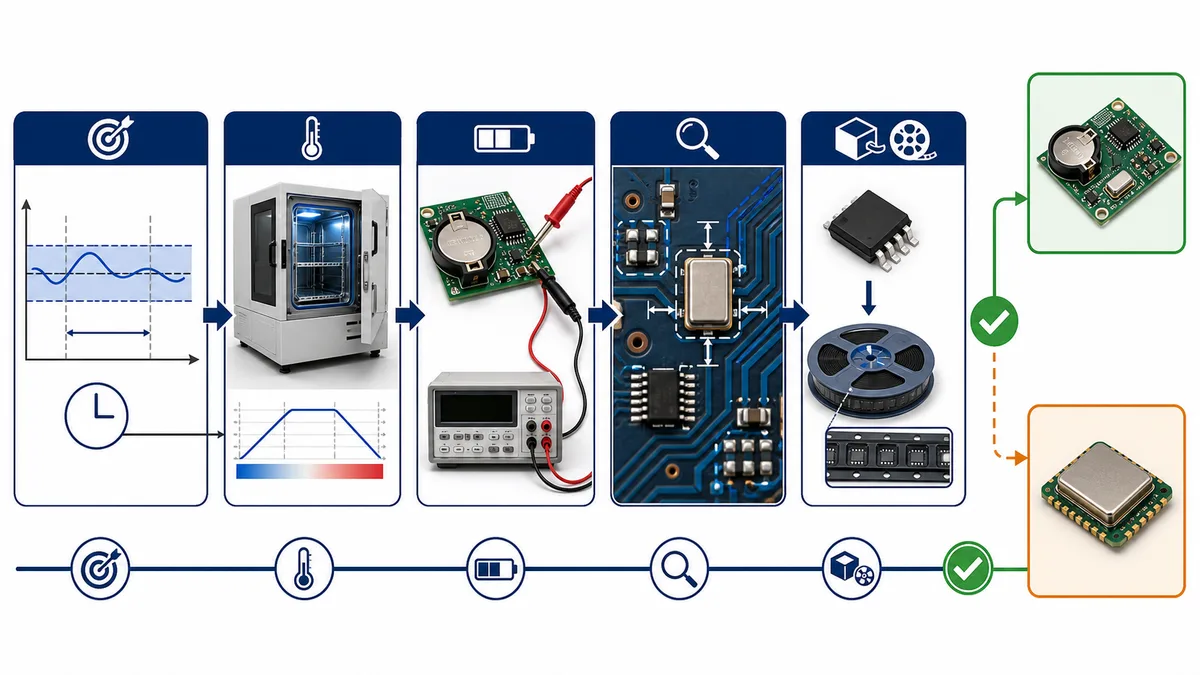
Design checklist
- Define allowed error and the longest interval without synchronization.
- Map operating and battery-backed temperatures.
- For DS1337, qualify a 32.768 kHz, 6 pF crystal and acceptable ESR.
- Keep the crystal close to X1 and X2; route digital signals away.
- Budget tolerance, temperature, load error, aging and test uncertainty.
- For DS3231, respect the documented initialization sequence.
- Verify current with the intended outputs, bus state and temperature.
- Test drift at temperature corners after assembly.
Procurement checklist
- Keep DS3231S# versus DS3231SN# and packing suffixes intact.
- Never approve an “integrated crystal” as a TCXO without a compensated specification.
- Lock external-crystal frequency, load, ESR, tolerance, range, package and aging.
- Confirm footprint. DS1337 options use 8-pin packages; DS1337C uses a 16-pin SO.
- Require current data sheets and change control for alternates.
Procurement insight: Treat an RTC and external crystal as a matched timing set. A substitution can change load error or startup margin even when its nominal frequency remains 32.768 kHz.
Citation capsule: DS1337 is designed for a 32.768 kHz crystal with 6 pF load capacitance. DS3231S and DS3231SN carry different operating grades: 0°C to +70°C for DS3231S and -40°C to +85°C for DS3231SN.
Frequently asked questions
These answers separate crystal integration from compensation and preserve the accuracy, power and temperature-grade details required for engineering and procurement decisions.
Is an integrated-crystal RTC the same as a TCXO RTC?
No. Analog Devices identifies DS1337C as a package containing an RTC and 32.768 kHz crystal, but integration alone does not improve accuracy. DS3231S adds temperature sensing and correction logic, producing a specified ±2 ppm band from 0°C to +40°C.
How much time can a 20 ppm RTC lose or gain?
Analog Devices converts ±20 ppm at +25°C to about 1.7 seconds per day or 10.34 minutes per year. That is a room-temperature illustration rather than a worst-case guarantee; uncompensated tuning-fork crystal error can become much larger at temperature extremes.
Can calibration make a crystal RTC equal to a TCXO?
Calibration can reduce error at a chosen temperature, but it cannot remove the crystal’s parabolic temperature response. Analog Devices notes that screened crystals can improve their room-temperature starting point, while high- and low-temperature inaccuracies remain substantial without active compensation.
Does a TCXO RTC always consume more backup power?
Temperature measurement and correction require energy, so compare the applicable data-sheet conditions. Analog Devices specifies DS1337 timekeeping current at 425 nA typical under stated conditions; DS3231 lists 0.84 µA typical battery timekeeping current at 3.63 V.
Should I specify DS3231S or DS3231SN?
Choose by qualified temperature range. The DS3231 data sheet rates DS3231S for 0°C to +70°C and DS3231SN for -40°C to +85°C. Preserve the complete suffix on the BOM, request for quotation and incoming-inspection record.
Which RTC architecture should you select?
A typical ±20 ppm crystal corresponds to 10.34 minutes per year at +25°C, while DS3231S specifies ±2 ppm from 0°C to +40°C. Choose TCXO when that accuracy difference protects a real requirement across service temperature. Otherwise, keep the simpler crystal architecture and validate its full error budget.
If the product regularly corrects time, consider DS1337. If it must hold accurate time alone, evaluate DS3231S and its exact temperature suffix.
Verification method and review cadence
ICEARTH checked the six official Analog Devices resources listed below on July 27, 2026. The review compared the DS1337/DS1337C and DS3231 data sheets with manufacturer material on accuracy, integrated-crystal packaging, temperature compensation, power and oscillator design.
This is a documentation-based engineering comparison. It does not claim laboratory drift, battery-life, reflow-aging or component-authenticity testing. Before design release, calculate the complete system error budget and verify the assembled board across its qualified supply, temperature and backup-power conditions.
Review this guide at least quarterly while its device examples remain in active selection guidance, and update it sooner after a cited data-sheet revision, PCN or PDN. Send documented corrections to [email protected] for checking against the controlling manufacturer material.
Sources
All six sources below are official Analog Devices primary technical materials. They provide the 32.768 kHz crystal requirements, ±20 ppm and ±2 ppm accuracy references, 64-second compensation interval, package distinctions and electrical limits used throughout this engineering comparison.
- Analog Devices, DS1337/DS1337C I2C Serial Real-Time Clock Data Sheet, Rev. 4, retrieved 2026-07-27.
- Analog Devices, DS3231 Extremely Accurate I2C-Integrated RTC/TCXO/Crystal Data Sheet, Rev. 10, retrieved 2026-07-27.
- Analog Devices, Timekeeping Accuracy, Automatic and Affordable, retrieved 2026-07-27.
- Analog Devices, FAQ About the Integrated-Crystal Package Option, retrieved 2026-07-27.
- Analog Devices, Power Considerations for Accurate Real-Time Clocks, retrieved 2026-07-27.
- Analog Devices, Design Considerations for Analog Devices Real-Time Clocks, retrieved 2026-07-27.
Continue the engineering review
From this guide to exact component data
Related component comparisons
These comparisons contain an exact product record linked in this article.
Browse product recordsAll engineering guidesSourcing resources